
Ivana Čeňková
Professor at the Institute of Translation Studies, Faculty of Arts, Charles University, Prague, Czech Republic. Head of the MA study programme in Interpreting. Course Leader of the European Masters in Conference Interpreting (EMCI) module. Graduate of the Institute of Translation Studies, Charles University, with Czech, French and Russian (1978), PhDr. (1980, Prague) and CSc/PhD. (1986, Prague) both in theory of interpreting. Habilitation in Translation Studies in 1993. Professor in the same academic field in 2008. Regularly cooperates with Czech non-profit organizations and trains their community interpreters and intercultural workers.
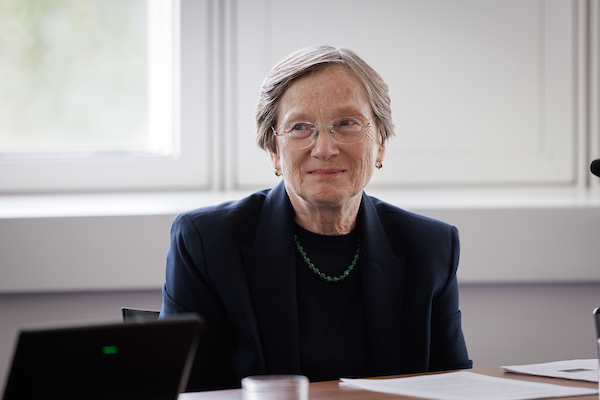
Practicing conference interpreter since 1979. Conference interpreter (EU accreditation – in 1993) and local coordinator of interpreting training for the European Commission, DG SCIC, temporary contract (2003-2005).
Author of numerous articles and publications on conference and community interpreting (theory, practice, didactics, reviews, reports) mostly in Czech, Russian, French and recently also in English.
President of the EMCI Consortium (III/2013-IX/2016). Member of the EMCI Consortium Governing Board (X/2016-IX/2022), actually member of the EMCI Consortium Research and Innovation Committee and of the Projects committee.
Member of ASKOT (Czech Association of Conference Interpreters), EST (European Society of Translation Studies), JTP (Union of Interpreters and Translators), Gallica (Association of Teachers of French language in Czech Republic), Jazykovědné sdružení (Association of Czech linguists).
Chevalier de l’Ordre des Palmes académiques (2004) and in April 2024 she received at ESIT the Danica Seleskovitch Award 2023.
For more information about her publications and academic career see: https://utrl.ff.cuni.cz/cs/ustavkatedra/lide/zamestnanci/prof-phdr-ivana-cenkova-csc/
I Still Don’t Have a Clear Answer to the Concept of Interpreter (In)Visibility – Do You?
In this keynote contribution, we will reflect together on how the perception of interpreter (in)visibility has evolved over time and across various political, social, and cultural contexts. Together with the participants, we will attempt to define the interpreter’s specific (real or potential) role and status.
We will examine two contrasting views: the interpreter as a mere conduit for communication, and the interpreter as an actively engaged intercultural mediator. I will briefly present the views of scholars who have addressed this issue, such as L. Venuti (1995), A. Kopczyński (1994), C. Angelelli (2004), C. Wadensjö (1998, 2008), F. Straniero Sergio (2012), G. Mullender (2014), U. Ozolins (2016), F. Pöchhacker (2004, ed. 2015), V. Duflou (2016), M. Bartlomiejczyk (2017), J. Trzeciak Huss and J. E. Huss (2021), M. Kadrič, S. Rennerts, C. Schäffner (2022), R. Li, K. Liu, A. K. Cheung (2023), E. Diriker (2004, 2025), among others.
We will be looking not only at the role and status of modern professional conference interpreters – whether elite consecutive interpreters at high level or simultaneous interpreters working in booths or through RSI – but also at the work of non-professional (volunteer) interpreters, media interpreters, court and healthcare interpreters, sports interpreters, and interpreters of national sign languages and International Sign.
Through a short interactive quiz with the audience, we will examine how new technologies and the Internet have influenced interpreter (in)visibility – through social media, personal websites, targeted online marketing – and, most importantly, ethical considerations. We will also reflect on the impact of the COVID-19 pandemic and the emergence of AI on this issue.
Together, we will aim to understand and define better interpreter (in)visibility in the face of the turbulent social, political, and technological challenges of the 21st century.
Our Sponsors
If you’re interested in sponsoring TIC 2025, please contact us for more information. We’re on hand to create a package that meets your needs, so do not hesitate to get in touch at: registration@tic-conference.eu.





The conference is a partial output of the following grants:
VEGA 2/0092/23 Translation and Translating as a Part of the Slovak Cultural Space History and Present. Transformations of Form, Status and Functions: Texts, Personages, Institutions.
VEGA 1/0214/24 Obraz prekladateľov a tlmočníkov v spoločnosti/The image of translators and interpreters in society.
APVV-23-0539 Príprava prekladateľov a tlmočníkov na budúcnosť: Zriadenie znalostnej platformy pre poskytovateľov jazykových služieb na Slovensku/Future-Proofing Translators and Interpreters: Establishing a Knowledge Platform for Language Professionals in Slovakia.
VEGA 1/0113/23 Špecifiká lokalizácie softvérových produktov v jazykovom páre slovenčina – angličtina/Localization of Software Products Specifics in the Slovak – English Language Pair.